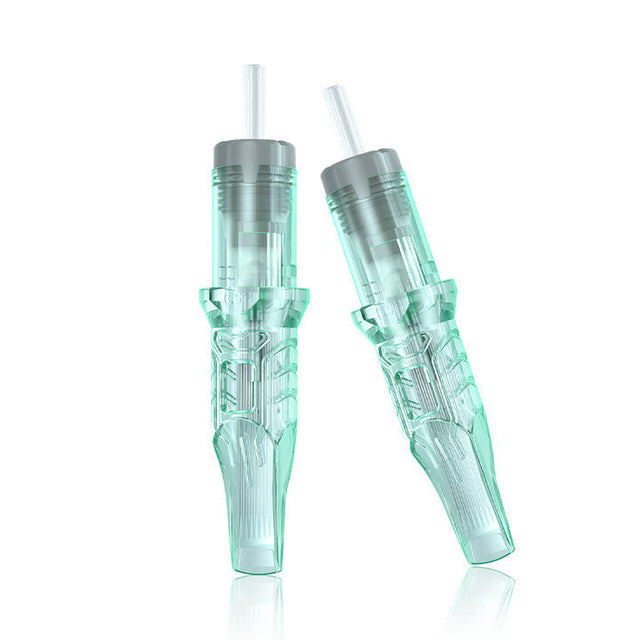
Choose the needle shape, then the diameter and grouping
Choose RL for defined lines, RS for compact fills, M1 for broad colour packing and RM for soft-edge gradients. Then match the point count to the space in the design and the wire diameter to the mark you want. In 1007RM, 10 means 0.30 mm wire, 07 means seven points and RM identifies the curved magnum arrangement; 08 means 0.25 mm and 12 means 0.35 mm. All four Thunder Pro families use 304 stainless steel needles, EO sterilisation and a standard universal cartridge connection, with boxes of 10 or 20. Choose 10 to introduce a configuration or keep a secondary size available; choose 20 to replenish a Style used regularly.
For a repeat order, keep the complete Style and pack together: 1005RS identifies 0.30 mm wire, five points and a round shader; the pack option supplies 10 or 20 cartridges. Two boxes of 20 supply 40 cartridges. Our tattoo cartridge reorder guide compares exact repeats with purposeful changes of diameter, count or arrangement.
Thunder Pro RL — choose the line before the grouping
Choose RL when the line defines the design: lettering, geometric contours, fine detail or a bold boundary. Its tightly grouped circular tip concentrates the working points. Start with 0803RL or 0805RL / 0.25 mm for finer grouped linework; choose three points for the smaller footprint or five for a broader one.
For a more substantial contour, compare 1007RL / 0.30 mm and 1207RL / 0.35 mm at the same seven-point count. A larger grouping belongs where the intended line has more width.
Thunder Pro RS — fill the smaller parts of the drawing
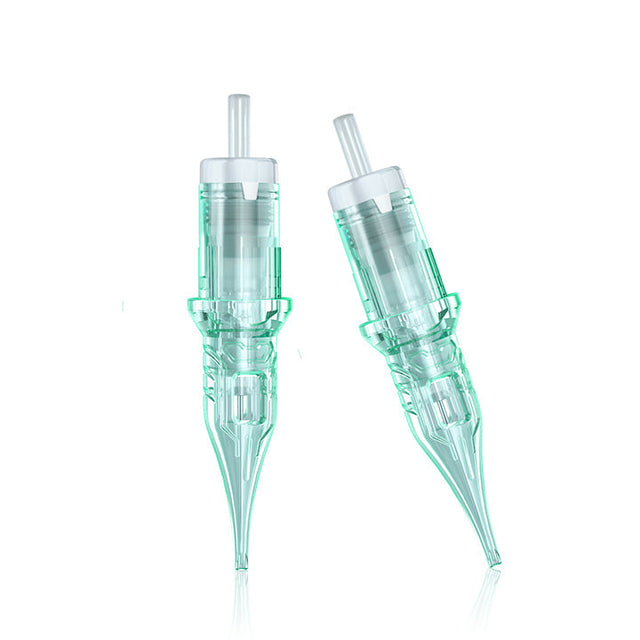
Choose RS for small colour shapes, local shading and texture with a round working footprint. Its open circular arrangement serves colour building inside the contour. Start with 1003RS for the smaller footprint or 1005RS for more local coverage.
Compare 1005RS / 0.30 mm with 1205RS / 0.35 mm to change wire diameter while keeping five points. Both diameter ranges offer 3, 5, 7, 9, 11 and 14 points.
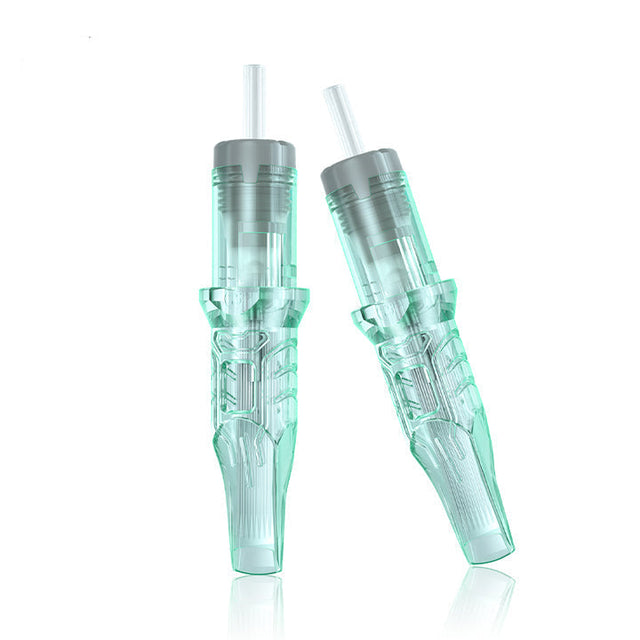
Choose M1 for solid colour fields, black backgrounds and directional shading. Its staggered rows form a broad, straight working edge, covering a wider strip than a round shader. Start with 1005M1 or 1007M1 / 0.30 mm for narrower shapes; choose 1015M1 for a larger field, or 1215M1 / 0.35 mm when more substantial wire suits the same fifteen-point grouping.
The 0.30 mm range offers odd-numbered groups from 5 to 27, and 0.35 mm from 5 to 23. Choose a width that fits the space between the design boundaries.
Thunder Pro RM — give gradients a curved working edge
Choose RM for black-and-grey shading, blended backgrounds and colour transitions where the curved tip profile serves a softer working edge. Start with 1005RM or 1007RM / 0.30 mm for smaller gradients; move to 1015RM when the shaded section opens up. Compare 1015RM with 1215RM / 0.35 mm for the same fifteen-point grouping with thicker wire.
The 0.30 mm range offers odd-numbered groups from 5 to 27, and 0.35 mm from 5 to 23.