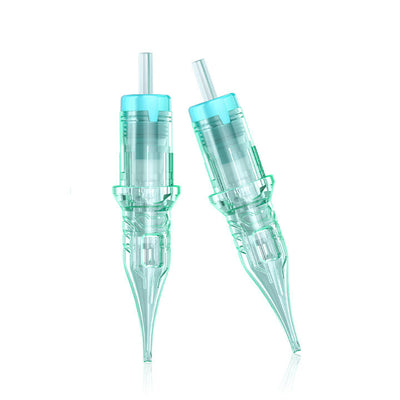
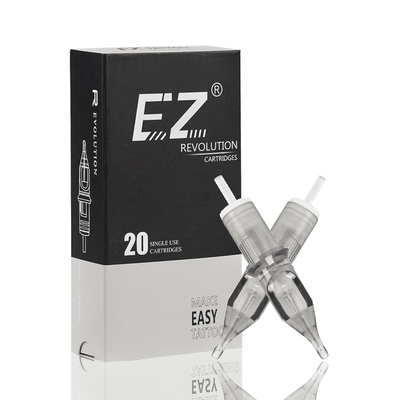
For a fine grouped lettering exercise on synthetic skin, start by comparing Thunder Pro 0803RL and 0805RL. Both use 0.25 mm wire; the count changes from three points to five. Give each cartridge the same lettering proof so you can judge which grouped footprint fits the intended lines and spaces in your own practice.
Lettering asks a liner to do several jobs within one design: straight stems, curved strokes, joins and small enclosed spaces. Choose the intended line character before choosing a cartridge. A compact single-line script and an outlined block letter can lead to different selections, even if they spell the same word.
Set the lettering task before the needle
Pick a short word containing the features you want to study. For example, a proof with straight stems, a rounded letter and a diagonal join gives you several distinct shapes to review. Decide whether each visible line is itself the finished mark or a boundary around an area that would be filled.
Round Liner (RL) groups the points into a concentrated circular tip for line-led work, including lettering and geometric detail. It is the starting family here because the exercise centres on the line. Keep a separate shader or magnum decision for an area-filling task.
Choose a scale at which the paper design communicates clearly. If the letters already close up or lose separation on paper, revise the design before changing needles. The cartridge choice becomes easier when the intended mark is visible in the proof.
Choose a focused first pair
Thunder Pro RL offers 0803RL and 0805RL as fine grouped starting choices. Both have 0.25 mm individual needles. Three points give the smaller grouping; five provide a broader grouped working footprint. Compare them when your question is which group fits the lettering you have drawn.
For an isolated single-point study, the same range includes 0801RL at 0.25 mm. Choose it when a single point is the configuration you want to evaluate. For a more substantial grouping, the 0.30 and 0.35 mm ranges provide further count choices. Keep the specific question clear rather than changing count and diameter together without a purpose.
If a named taper or tip version is central to your current setup, Revolution RL provides those separate choices. Start with the exact version you want to assess; its factory style name belongs alongside count and diameter in your record.
Keep the paper proof constant
Prepare equivalent copies of the same lettering at the same scale. Label the synthetic practice areas with the complete cartridge Style and keep your machine setup recorded. Use the same objective for each area: for example, following the stems and curves of a single-line word while preserving the open spaces in the design.
This creates a comparison you can read afterwards. Mark the same letter features on each proof: a straight stem, a tight curve, a join and an enclosed space. Review the resulting practice marks against those features rather than judging only whether one sample looks darker.
Keep a later change separate. After choosing between three and five points at 0.25 mm, a new study can compare wire diameter within the selected count. The tattoo cartridge code guide helps identify the exact geometry before you select that next pair.
Review the letter, then complete the selection
Look for the parts that make the word readable: consistent intended stems, recognisable curves, distinct joins and spaces that still belong to the design. Note which cartridge footprint you prefer for those shapes within your established practice method. Synthetic-surface observations help you organise equipment practice; they are not a promise about a tattoo's healed appearance.
Our first pair remains 0803RL and 0805RL for a fine grouped study. Keep the one that serves the intended line and retain the other only if it has a separate role. A ten-cartridge Thunder pack is useful for introducing a Style; a twenty-pack suits one that becomes regular in your work. Choose the actual configuration and pack in the live selector for its current price.
You finish with a reason for the purchase: a defined lettering task, a chosen geometry and a quantity that fits how often you use it. That is more useful than choosing the largest available grouping or calling one needle the answer to every lettering style.
Questions about lettering practice cartridges
Why compare 0803RL with 0805RL first?
Both use 0.25 mm wire, so the comparison changes count from three to five within the same RL family. It gives you a focused grouped-footprint question for the same lettering proof.
Should I use a single point for every small letter?
Choose according to the line you have drawn and the configuration you want to study. Thunder 0801RL is a single-point 0.25 mm option; 0803RL and 0805RL provide grouped alternatives for a distinct practice comparison.
What should stay with the practice photograph?
Keep the lettering scale, full cartridge Style, machine setup and the particular letter features you reviewed. This makes the image useful when choosing the next exercise or replenishing a configuration.