

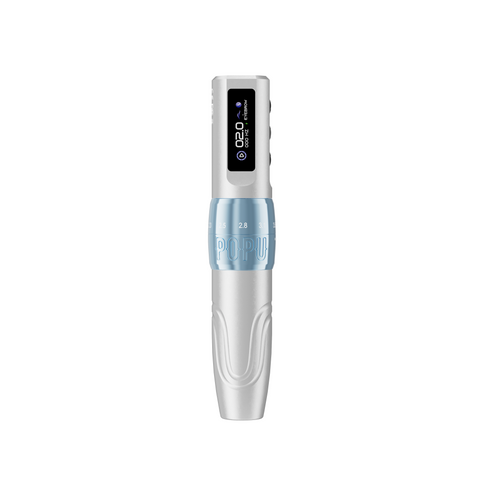

Put the Black Biomaser TP010 Kit on the supply list when a first brow cohort is learning line placement and soft shading. Its 12 V Swiss coreless motor drives a fixed 3.0 mm handpiece, giving the whole class the same mechanical stroke while students compare marks. For a course that explicitly teaches students to compare stroke positions, start with the Black Biomaser U1 with two batteries so they can make the comparisons themselves.
Compare the configurations on a single station
| Course requirement | Black Biomaser TP010 Kit | Black Biomaser U1 with two batteries |
|---|---|---|
| Mechanical stroke | Fixed 3.0 mm | Six positions, 2.0–3.5 mm |
| Power supplied | Two battery heads | Two batteries |
| Cartridge connection | Standard universal | Standard universal |
| Bench supplies | Starter cartridges and pigment cups included | Budget the teaching cartridges and cups separately |
| Best curriculum match | Repeat a shape with the same mechanical response | Compare stroke positions as part of the assessed exercise |
The fixed machine is the more direct choice for a group just learning to put the same mark in the same place. When all stations use the same mechanical stroke, the instructor can start with visible differences in placement and shape during a correction. The kit also gives an empty station a starting set of supplies without asking every student to assemble a different basket. Reserve the adjustable U1 for a curriculum that makes stroke a meaningful part of the lesson. It gives students two changes to compare independently: the mechanical setting and the footprint they get from another grouping.
Decide what students must be able to explain
Draw two short brow shapes with a narrow front and a small soft tail. In an introductory class, ask students to make the same sequence on both shapes using the fixed TP010 and to identify where their repeat begins to differ. Put the 0601RL on the front exercise and the 1003RS on a separate tail exercise. In a class teaching the adjustable collar, make two rows of the same tail mark with the same grouping. Change only the stroke between rows so the student can describe what felt different at the hand. Keep a separate row for the change to the liner. Both exercises work on flat synthetic material where students can compare starts, endpoints and the spread of marks without trying to read a result on skin.
Buy the teaching groupings by the job each one does
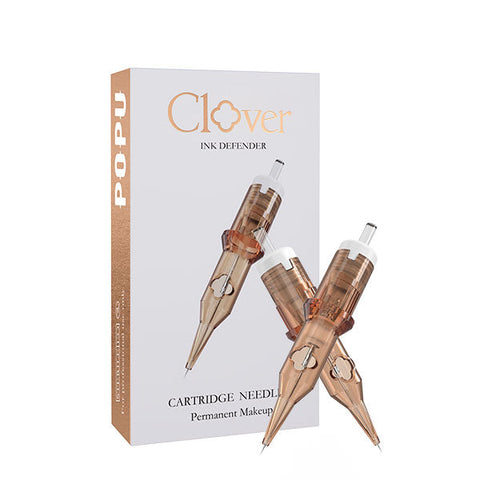
The 0601RL has one 0.20 mm point for a narrow individual mark. The 1003RS uses three 0.30 mm points for a larger soft-coverage footprint. Both Pinky Pro groupings use EO-sterilised 304 stainless steel needles, clear PC bodies and silicone anti-backflow membranes. The clear bodies let learners see the cartridge assembly as the instructor explains the hardware. The membrane provides a barrier toward the handpiece. Buy both groupings in their 20-packs when every station needs the same line and shade exercise. Divide the class needs by the pack size and round up each grouping separately so the liner count does not hide a shortage of shaders.
Give each lesson one change students can see
With the TP010, demonstrate a short stroke and a narrow shaded edge on the same practice shape. Give the class the same pen and grouping for each task. If one student sees a different result from the demonstration, compare the shape and spacing of the marks first. The kit also supplies two battery heads, starter cartridges and pigment cups, so new stations can begin with the same basic setup.
The U1 makes more sense when the curriculum includes a second exercise with the cartridge and shape held constant while students try two of the pen’s six 2.0–3.5 mm stroke positions. Compare which setting lets each student repeat the intended mark on silicone before changing the grouping. Two batteries give each U1 station a spare to keep ready between teaching blocks.
Use one pair of groupings across the cohort
Both machines take standard universal cartridges. Choose Pinky Pro 0601RL, 20-pack for the single-needle line exercise and Pinky Pro 1003RS, 20-pack for the shading exercise. Give students a flat A4 silicone sheet with room for several rows of marks.
Order the Black TP010 Kit and both Pinky Pro boxes for an introductory brow class. For a class where changing the stroke is an assessed skill, order the Black U1 with two batteries and use the same two boxes.
FAQ
Can an instructor use the same cartridges on either model?
Yes. Both use standard universal cartridges. The 0601RL gives the class a 0.20 mm single liner and the 1003RS gives it a 0.30 mm three-needle round shader.
Should a first course pay for adjustable stroke?
Choose the TP010 Kit if the lesson is about repeating a shape and refining line placement. Choose the U1 if students will compare stroke response and explain their choice as part of the lesson.
What should an academy add to the dual-battery U1?
Add both Pinky Pro boxes, pigment cups and flat A4 synthetic practice material. The U1 supplies the machine and two batteries, so plan the exercise materials as separate items.
Should students switch needles and stroke at the same time?
For an exercise that assesses stroke, keep the grouping and practice shape the same while changing the setting. Compare the second grouping in a separate exercise.