


Choose organic, inorganic or blended PMU pigment through the exact formulation and the colour role you need. Organic and inorganic describe colourant chemistry; a finished bottle may combine several colourants. For your purchase, match the application, depth and undertone first, then use the ingredient identity to understand the shade you selected.
A warm brown and a neutral brown can serve different designs even when both contain several colourants. The useful question is which finished shade supports the work. Chemistry helps explain what is inside that shade; the working palette turns that information into a choice.
What the categories mean
Organic pigments include colourants with organic molecular structures, such as Pigment Red 170. Inorganic examples include iron oxides and titanium dioxide. These are chemical categories, separate from botanical sourcing or organic-farming terminology. The Colour Index classification identifies colourants by their names and constitution numbers.
Carbon black illustrates why “contains carbon” alone is an incomplete shortcut. Colour Index discusses its characteristics across both pigment groups. Identify the particular colourant and formulation rather than classifying a bottle from a marketing word.
A Colour Index (CI) number identifies a colourant. The PMU bottle also contains the finished formulation around its colourants, so the shade code and product information belong alongside the chemical identity.

A concrete example: a blended brow shade
Biomaser's source information for Light Coffee / BPE03 lists carbon black CI 77266, iron oxide red CI 77491 and Pigment Red 170 CI 12475. It is a useful example of several colourants contributing to one finished brown.
PubChem identifies Pigment Red 170 as a specific molecular compound. The iron oxide is a different type of colourant. Reading those identities gives you more information than describing the bottle with just one broad category.
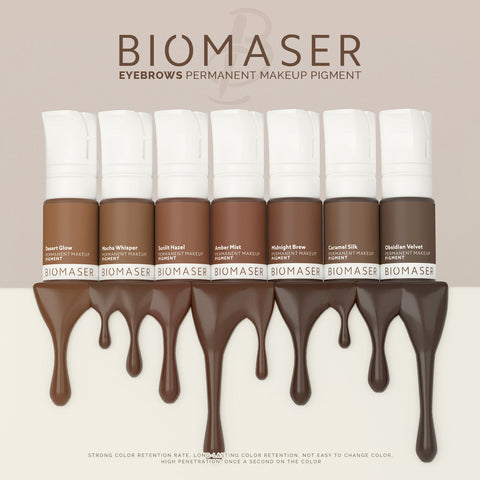
For the purchase itself, BPE03's role is a lighter warm coffee direction in the Biomaser Blend brow palette. Choose it when your colour plan calls for warmth and softness together. Choose medium-neutral BPE02 for the central everyday brown role or BPE05 for deeper warm definition. That is where the formulation becomes a useful working choice.
Choose the finished shade for the design
For brows, compare depth and undertone together. The light neutral BPE01, medium-neutral BPE02 and deeper warm BPE05 have distinct roles. BPE06 gives deeper neutral coffee and BPE07 a deeper cool direction. A small purposeful palette can begin with BPE02 and the lighter or deeper option used most in your appointments.
For lips, the Biomaser Blend lip range includes pink-coral BPL01, pink BPL02, mauve-based nude-brown BPL07 and red roles BPL10/BPL11. Choose by the planned hue and definition. Several formulations can contain organic and inorganic components, while their finished colour roles remain different.
For liner, choose BPB02 for softer brown definition or BPB01 for a stronger black accent from the Biomaser Blend eyeliner range. The colour task still leads the choice.
Put compliance and colour into the same purchase
Biomaser Blend pigments comply with EU REACH and are built to the highest professional quality standard. Use that confirmed standard alongside the exact application and shade information. Compliance, formulation identity and working colour are useful parts of one purchase decision.
Retain the product name, shade code and batch information with the stock you use. If an ingredient document matters to the work or market, request it for the exact shade through ATTO support. This makes the request specific and keeps it connected to the product you plan to order.
Our selection recommendation
Choose the finished colour role first, then understand its formulation through the product's ingredient identity. Start the brow palette with BPE02 and add BPE01 for softness, BPE03 for lighter warmth or BPE05 for deeper warmth. Use the brow, lip and liner pigment guide to compare the working roles across the range.
Frequently asked questions
Does organic mean plant-derived?
In this context it describes pigment chemistry. Organic pigments can be synthetic; botanical sourcing is a separate product claim.
Can a bottle combine pigment categories?
Yes. The BPE03 source list includes several colourants, including iron oxide red and Pigment Red 170, in one finished shade.
Which category lasts longer?
Longevity is a question about the complete product, technique and individual result. Use product-specific evidence for a durability claim; choose the working palette by application and colour role.