

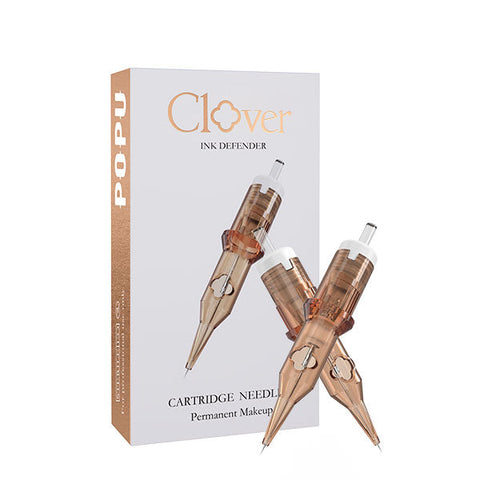

A useful brow map stays readable at the front, arch and tail. On a silicone sheet, Pinky Pro 0601RL is the first cartridge to order for tracing those guides. Add Pinky Pro 1005F when the exercise moves from tracing a boundary to shading the narrow band next to it.
Compare the tip that traces and the tip that covers
| Selection factor | Pinky Pro 0601RL | Pinky Pro 1005F |
|---|---|---|
| Number of needles | One | Five |
| Individual diameter | 0.20 mm | 0.30 mm |
| Working shape | Single point | One straight row |
| Connection | Standard universal | Standard universal |
| Role in the mapped exercise | Trace landmarks, corners and tapered detail | Build a narrow band inside a mapped edge |
| Buy first when | The assignment is readable placement | The map is established and coverage is the next assignment |
One point lets you follow a specific route through a curve. The flat has a longer working edge, so its orientation and the width of the available area matter. Use the narrow point where the map turns at the arch or ends at the tail. Give the flat a section with enough room for its row so you can compare a small band of even coverage. When an exercise has both tasks, the two boxes do different work. The single point establishes whether the outline follows the map. The flat shows whether the interior can stay visually connected to that boundary.
Use three landmarks to read the exercise
Draw two identical maps on a synthetic sheet. Label the front, arch and tail on the sheet outside the working outline. In the first copy, trace one section at a time with the 0601RL, then step back to see whether the landmarks still lead the eye through the intended shape. In the second, add the narrow shaded band under the longer part of the body. As the area tapers, check where there is still room for the straight row. This gives the purchase a concrete test. If placement is still the main issue, repeat the first exercise with the fine liner. If the map already reads and the band is the next skill, add the flat and keep the liner for corners.
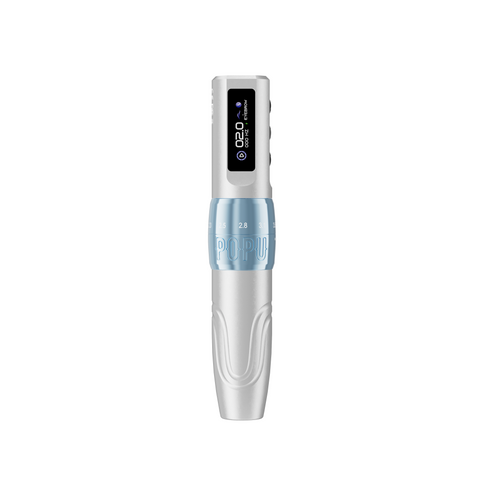
Both Pinky Pro options use EO-sterilised 304 stainless steel needles, clear PC bodies and silicone anti-backflow membranes. The clear body makes the assembly visible and the membrane provides a barrier toward the handpiece. You can keep the construction and compatible pen the same while changing the geometry. For a course, give learners the two groupings as separate consumables so they can make the comparisons without trying to use one tip for both jobs.
Draw the map, then test the boundary
Make a pencil map on your practice layout and duplicate it beside the first. Mark the front, the highest point of the arch and the tail before you pick up the pen. Trace the first copy with 0601RL. Its single 0.20 mm needle gives you a focused point for seeing whether you can reach the corner of the arch and change direction cleanly. Compare the spacing and outline of the two maps before you add color.
Use the second copy to check how a shaded area sits next to your map. The 1005F places five 0.30 mm needles in one straight row. On a short section beneath the brow body, use the flat footprint to work inside the marked boundary. The useful result is a narrow band that follows the map while leaving the outside of the shape clear.
When to add the flat
Buy the flat after you can trace the map you intended and want to see whether directional coverage follows it. At a tight corner or tapered tail, go back to the single point to check the line. A flat earns its place along a section with enough room for its straight working edge.
Frequently asked questions
Do I need a cartridge to make the initial brow map?
Use your mapping tools for the initial layout. The cartridge comparison comes after you have copied the guide onto a synthetic practice surface.
Which practice surface lets me compare the two cleanly?
A flat A4 silicone sheet lets you place two identical guides side by side and see where the shaded band follows the boundary.
Can I do both exercises with the same universal pen?
Yes. Both linked groupings use the standard universal connection. Compare the different footprints on the same compatible pen and flat practice sheet.
Which part of the map should I shade with the flat first?
Start inside the longer mapped section under the brow body, where there is room for the flat's straight row. Keep the narrow arch corner and tapered tip for the single-point comparison.
Order Pinky Pro 0601RL, 10 cartridges with A4 silicone practice skin. Add Pinky Pro 1005F, 10 cartridges for the shading exercise.